The lenses of 2DIE4 with the Abdala Brothers & Dan Sasaki
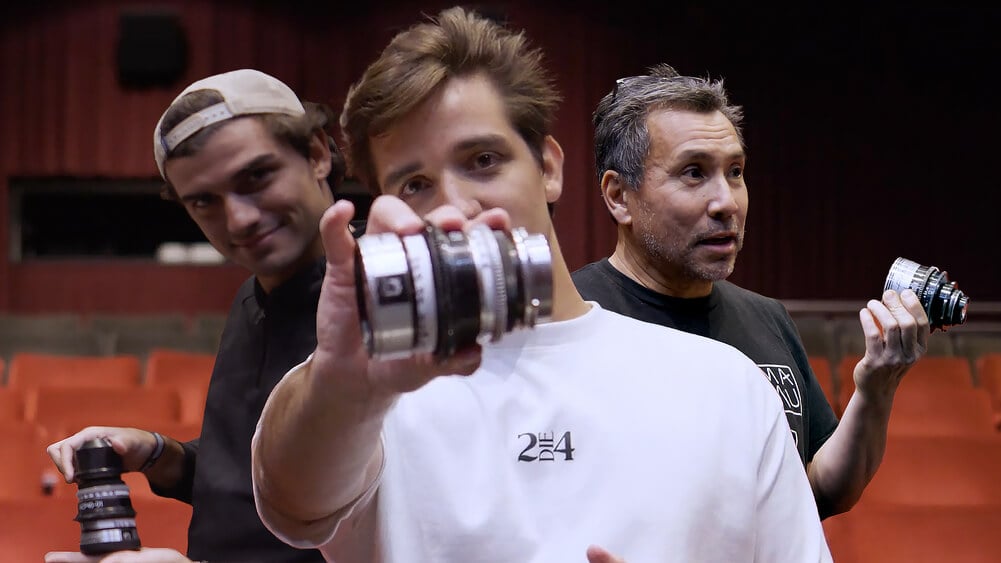
Ahead of the release of their racing documentary 2DIE4, brothers and co-directors Salomão and André Abdala returned to Panavision’s Woodland Hills headquarters and caught up with Senior Vice President of Optical Engineering and Lens Strategy Dan Sasaki. In this video, the trio discuss the lenses that the brothers selected for their movie, including Panaspeed, H Series and System 65 primes and a Primo telephoto zoom they nicknamed “the bazooka.”
About the Panaspeeds, which were used to capture racing action, Salomão says, “This lens is very interesting to me because you have what I love the most about characteristics without losing resolution, contrast and everything else.” Meanwhile, the H Series and System 65 lenses were used for more intimate moments. “We needed to be able to hold a large-format camera in our hands and to pull focus with one hand and operate with the other,” Salomão adds. “I think one of the most important parts was seeing that the H Series was small and light but still very fast.”
Watch the video below to hear what else the brothers and Sasaki had to say about the full range of optics that were used on 2DIE4.
Throughout the conversation between Sasaki and the Abdalas, pop-up definitions appear onscreen to provide additional context or information related to names and technical terms that are mentioned. For reference, here are those definitions, along with the timecodes at which they appear.
01:33 – Patrick Leplat is the managing director at Panavision Paris and worked closely with the Abdala Brothers as they prepped for principal photography of 2DIE4.
03:19 – Bokeh refers to the quality and appearance of out-of-focus areas in an image, especially highlights.
03:38 – Examples of optical aberrations include astigmatism, spherical aberration, and geometric distortion.
03:53 – Astigmatism is an optical aberration in which a ray bundle has a difference in focal length between the perpendicular tangential and sagittal planes, creating a blurred image.
04:03 – Spherical aberration occurs when light rays passing through a lens converge at different focal points, resulting in a blurred or soft-focus image.
04:31 – Veiling glare is a type of luminance change in which light is a scattered, resulting in a haze over the image, lifting black levels and reducing contrast, with no clear shape or boundary.
04:55 – A film stock’s anti-halation backing absorbs light, preventing internal reflections that could otherwise produce a halo or blooming effect around bright sources.
05:59 – Photographed by Oscar-winner Hoyte van Hoytema ASC FSF NSC, Oppenheimer was directed by Christopher Nolan and counted Robert Downey Jr. (aka RDJ) among its cast.
06:25 – A capture format’s diagonal refers to the straight-line distance from one corner of the imaging area (e.g., the camera sensor) to the opposite corner. A lens that covers the diagonal will not vignette.
07:31 – Measured in degrees, field of view indicates how much of the environment in front of the camera is visible through a given lens. A wider-angle lens will produce a greater field of view than a longer focal length.
08:34 – Different focal lengths will achieve comparable fields of view on different capture formats. E.g., a 15mm focal length on 35mm format produces about the same field of view as a 30mm lens on large format.
13:08 – Before Panavision developed its patented anomorphosing system in the 1950s, anamorphic lenses stretched subjects horizontally as they got closer to the camera, a form of distortion referred to as the “anamorphic mumps” or mumping.
Related Products and Services
This is a carousel with manually-rotating slides. Use Next and Previous buttons to navigate.


