The Abdala Brothers on the making of 2DIE4
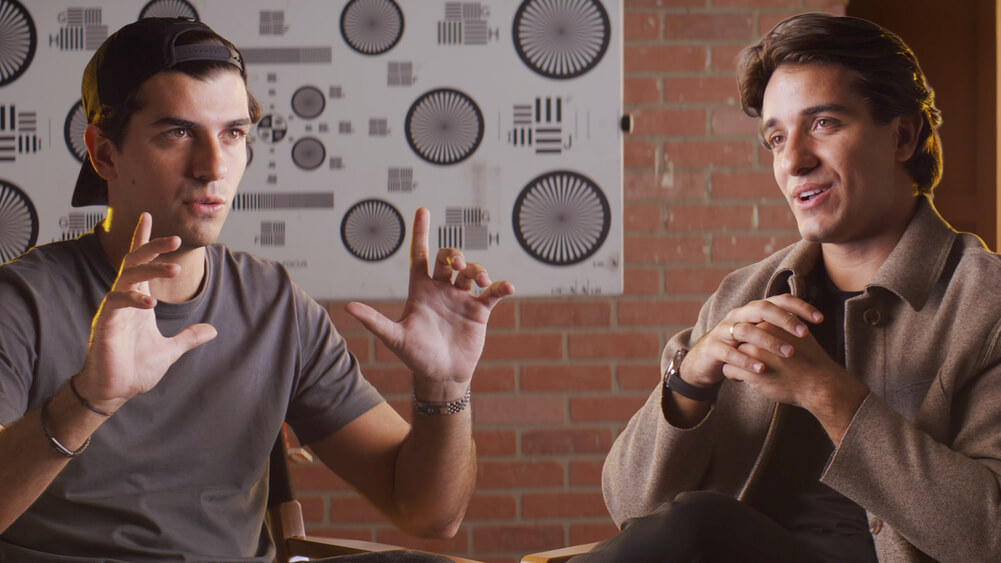
Co-directed by brothers André and Salomão Abdala, the documentary feature 2DIE4 follows Brazilian racing driver Felipe Nasr through the 24 Hours of Le Mans endurance race. Blending documentary authenticity with cinematic storytelling, the Abdala Brothers sought to create an immersive experience that places the audience directly inside the 24-hour race’s emotional intensity.
“We wanted to make a film about a real story,” Salomão shares. André adds, “Having a real race happening, a real pilot, a real team, that's as real as you can get. We really wanted to have that realistic approach on the film.” In this exclusive video, the filmmakers discuss collaborating with Panavision, detail their lens choices, and bring viewers inside their small crew’s shared creative vision and passion for the craft.
Camera Prep
Salomão reflects that as he and his brother were growing up in Brazil, “we started making videos, and filming our friends with GoPros, and learning how to make videos on YouTube, which was some of the coolest things we've ever done because that hobby became actually a profession and then actually became our job and what gets us through life.”
During preproduction on 2DIE4, the Abdalas worked with the teams at Panavision Woodland Hills and Panavision Paris to assemble their lens and camera package. “Panavision has been in our radar since we learned what filmmaking is,” Salomão says.
André adds, “It was awesome that we could have Panavision with us during the whole project because we wanted to have that look. It's a documentary that we're filming, but we want it to feel like a film. When you're talking about the drive motif, that is the main reason for the film, that we wanted to show what an obsessive artist would do for his love.”
Lens Choices
One particularly important visual reference the Abdalas shared came from Christopher Nolan’s film Oppenheimer, with cinematography by Hoyte van Hoytema ASC FSF NSC. André explains, “There's one scene in Oppenheimer that stuck to me with Robert Downey Jr. when he's in the car, and they're literally on his face. You're literally there with him. And with the large sensor, with that beautiful lens, you're really in there with him, but there's no distortion. The image is beautiful. And you feel like you're in his personal space, you can judge him, but there's no dialogue. And when I saw that, I was thinking, ‘Okay, I want to make a film on that idea, on that scenario, with that feeling.’”
Salomão adds, “So this is something that I talked [about] with Patrick [Leplat] from Panavision Paris. ‘How can we emulate the look of Oppenheimer?’ Patrick managed to get us the System 65 [lenses]. It was able to produce what we wanted — I wanted to have a lens that will separate Felipe from the background. It would separate Felipe from the outer world. Instantly, when I tested those lenses, they became the Felipe lenses.
“And then we have the action lenses, which are supposed to shoot the garage, they're supposed to shoot action,” Salomão continues. For the action lenses, he explains, “We went two ways. The first way, we went with the Panavision Primos, which are very sharp, very detailed and very cool contrast. They don't flare a lot, but Patrick modified them for us so they could add some more flaring. The other lenses that we were using was the Panavision H Series. And it was super important for me to use the H Series because they have a nice background separation, but they are super small, super lightweight.”
Principal Photography
For principal photography, Salomão says, “we had a very small crew of only seven people. Of the seven, six were camera operators, including me and my brother. Everyone was operating their own camera, they were directing their own camera, and they were pulling focus off their own camera.
“We have one specialty camera that is going to stay only in the garage,” he continues. “And then we have four RED cameras with four different Panavision lenses. Those are all super small [and] can be operated handheld. And then there's the other camera, which was the ‘Bazooka.’ And the Bazooka was with my brother. He loves the big, big camera.”
The “Bazooka” earned its nickname because of the long 24-275mm T2.8 Primo zoom lens that stayed mounted on the camera body. “This lens is the most incredible lens in the world because you have a super-wide 24 [millimeter], and then you can zoom into 275,” Salomão enthuses. “And what we made with this camera is we installed a focus motor that was very, very fast for the zoom, and [André] could zoom in and zoom out with his thumb and focus with his other hand.
“Because he was using a high-speed camera, he could do a crash zoom, like very Tarantino-esque, very, very fast,” Salomão says of André’s camerawork. “But when you're watching in 1,000 frames, it's a super slow tracking shot, zooming in. So it looks like the camera is not on a tripod. It looks like the camera's following the car, but it's actually just a zoom, slow motion and [panning].”
Shared Vision
Giving credit to their tight-knit crew, André notes, “We're a team that have been working together for more than five years, six years together. We're really young, so that may be not so much for the people in the industry, but for us, we've been building this relationship.”
With 2DIE4, he says, “It was something that everybody had their mentality, and the visual language really aligned, and everybody understood the story. I'm really proud of that because I think we built a team that is super aligned. We had a really good pre-production, like understanding everything that could happen on the race. I'm so grateful for everyone who was part of that project because all the guys, they believed in everything that we were doing there, and they delivered everything that it could be.”
Capturing Dreams
Reflecting on his and André’s collaboration with Panavision for 2DIE4, Salomão muses, “Basically what filmmaking is, is what Panavision is. It's like the story of filmmaking, why people make films is to give life to their creative thoughts. How can you make a motion picture of your dream?
“I really want to see how far we can get,” he continues. “What's the best story we can tell? What's the best film we can make? And that's why we put everything that we have on every project that we do. This right now is the most important project that we've done, and I've never put my heart so hard on something like that, but I've done this on every other project, and I think that's why we're here. So we're very lucky to have been two guys who followed their dreams, and their dreams in the end paid off.”
Related Products and Services
This is a carousel with manually-rotating slides. Use Next and Previous buttons to navigate.


