Michael Goi ASC ISC on mentors and mentoring in cinematography
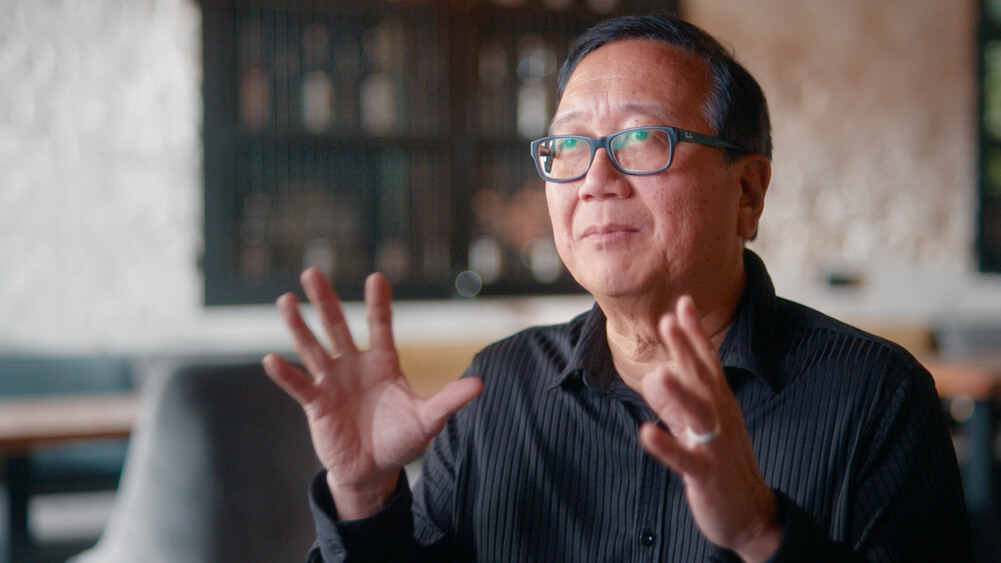
As cinematographer, director and producer Michael Goi ASC ISC explains it, filmmaking is a living process, one that evolves on set and in collaboration. In this conversation, Goi reflects on his career journey to date — a journey that has been defined by tenacity, mentorship, and a commitment to pushing himself beyond his comfort zone. From shooting his first television commercials as a teenager, through his three terms as president of the American Society of Cinematographers, Goi’s path is itself a master class in sustained curiosity.
Staying Uncomfortable
As Goi shares, there’s tremendous creative inspiration to be found in working outside of one’s comfort zone. “You have to be uncomfortable every single day that you're working,” he says, “because if you're not, then it means you're doing exactly what you did before. That monotony, I think, ultimately kills your creative impulses.”
As examples within his own career, he says, “When people point out to my work on American Horror Story, or an Avatar: The Last Airbender, or whatever it is, they're pointing out work where I ventured into doing stuff that I had never done before.”
Creating Opportunities
Goi goes on to share, “People always ask me, ‘What was the big break?’ Honestly, I feel like I'm still waiting for the break. The thing that I will give myself is that I was never content to wait for opportunities to come up. I wanted to make professional movies by the time I reached the age of 14, and so I saved up enough money to get a 16mm wind-up Bolex camera. And I saw a truck down the street that was selling aluminum siding, and I recognized the name on the truck because they had some of the worst commercials on Spanish television in Chicago. And I did a dozen shots of their workers hammering up aluminum siding, and I was yelling at the workers, ‘Smile! Smile when you hit it!’ And they didn't know what I was saying and thought I was crazy. And then I shot the name of the company and the phone number on the truck, and I called the owner of the company, and I said, ‘I just shot your next television commercial.’”
Although Goi’s phone call came as a surprise, he says, the company “paid to have the film processed, and they cut it together into a 30-second spot, and they put Spanish narration on it. And that was the first commercial I did. So by the time I graduated from high school, I had 12 television commercials on the air on Spanish television.”
Cinematography Mentors
Although unafraid to create his own opportunities, Goi is also eager to credit the many mentors he’s had throughout his career. “There's certainly mentors all along the path,” he says. “George Spiro Dibie [ASC], who was the president of the Camera Guild, he took me around to various seminars and had me do lighting demos and instruct students or upcoming cinematographers because I was very quiet, but George opened me up in that respect.
“Vilmos Zsigmond [ASC HSC] was a great mentor,” Goi adds. “When I first moved to Los Angeles, there was a very low-budget film that I had shot that they were going to screen at the Egyptian theater. So I sent out postcards to all my cinematography heroes, Conrad Hall [ASC], Haskell Wexler [ASC], all of them. And Vilmos actually showed up with one of my postcards in his hand. And I ran up to him, and I said, ‘Vilmos, I can't tell you what it means to me that you came to see my movie.’ And he said, ‘Well, you invited me, so I came.’ And that turned into an association with him and Laszlo [Kovacs ASC] that lasted for years, through my presidency at the ASC.”
From Cinematography to Directing
For the last decade, Goi has primarily worked as a director, collaborating with other cinematographers. “The directing came as a natural extension of my cinematography work,” he shares. “I had directed three low budget feature films before I actually got the opportunity to direct professionally on American Horror Story.”
From his cinematographer’s perspective, Goi adds, “The challenges of working with the different directors are largely good challenges. You're looking for a perspective that's maybe different than your own. I never like to assume that I have all the answers — or certainly not all the right answers. The first idea is always the most conventional way to do something, so I always throw away the first idea.
“The environment of being on set for me is an active and a fluid one,” he continues. “Part of the reason why I stand behind the A-camera operator and I'm never at video village when I'm directing is because I can breathe down the dolly grip's neck, and I can say, ‘Oh, oh, let's push in here,’ even though that wasn't rehearsed. It's a living, breathing, evolving thing where I can react to things on the fly and make the shot that much more special.”
Mentoring the Next Generation
Since the early demos he gave under George Spiro Dibie’s mentorship, Goi has been dedicated to giving back to the filmmaking community, tirelessly volunteering his services to the ASC, the Academy of Motion Picture Arts and Sciences, and other industry institutions, and leading countless workshops, seminars, master classes and more. “Every Saturday that I'm in town, I do a movie night in my theater,” he shares. “Twenty or 25 people I happen to be mentoring at that time come. We talk about those films and why they're great, or sometimes not so great, because you learn as much or maybe more from a movie that doesn't work than a movie that does work.
“Helping and instructing the next generation of cinematographers, image makers, directors, is the most important thing that I can do, certainly more important than anything I will direct or shoot in my career, my lifetime,” Goi says. “Being able to work with the young cinematographers and see in their initial works that there's something special there, there's a unique way of seeing the world — being able to nurture that and help it along is just very gratifying.”