Ben Fordesman BSC on the making of Anemone
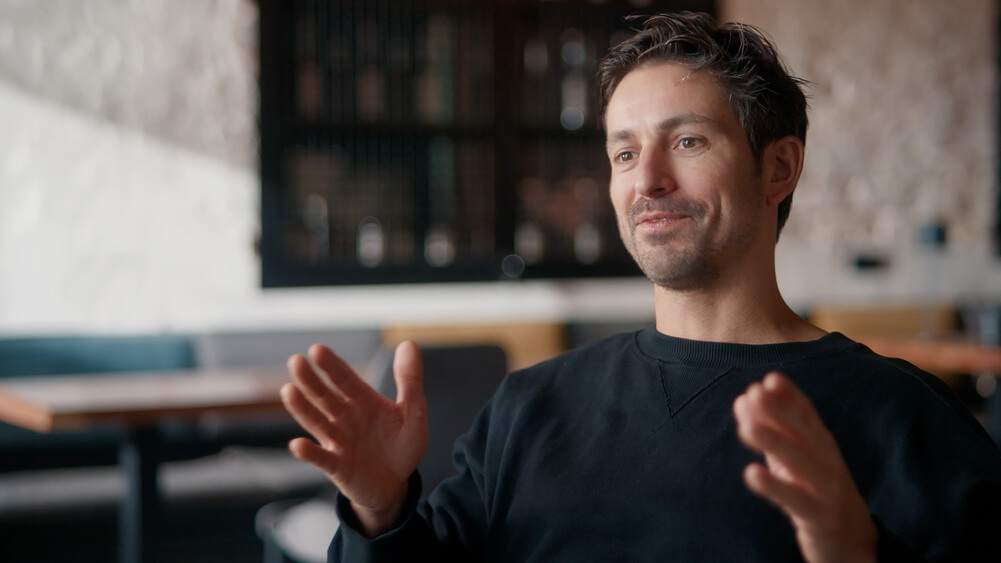
Ben Fordesman BSC is the cinematographer behind such notable independent features as writer-director Rose Glass’ St. Maud and Love Lies Bleeding, Dylan Southern’s The Thing With Feathers, and Ronan Day-Lewis’ Anemone. Fordesman began his career as an electrician and gaffer before notching cinematography credits in music videos and commercials and eventually branching out into narrative features. In this video, Fordesman discusses his approach to shooting Anemone, for which he collaborated with the teams at Panavision and Panalux in London for his camera and lighting packages. As he explains, he strove to focus on the performances through composition, minimal lighting, and restraint.
Fraternal Fight
Anemone is a film about estranged brothers, where much of the drama lives in the performances of Daniel Day-Lewis and Sean Bean. “Daniel Day-Lewis plays Ray,” Fordesman explains. “He abandons his partner who’s pregnant with their son. He goes off into the wilderness, and it’s just about a discovery and this re-connection between two brothers and family.”
Restraint became Fordesman’s aesthetic of choice as he endeavored to bring forward the subtle expressions of each actor, revealing the layers of their characters’ psychology. “I’m just endlessly fascinated with lighting the face, and I think in a sort of interior space it just opens up a sort of kaleidoscope of options,” he says. “What I loved about Anemone was there’s so many intense two-handers. It feels almost kitchen sink, social realism, just this intense dialogue, very long monologues, two people talking in a room. It just immediately spoke to me to say that these scenes need to be handled with a visual restraint, static compositions, allow that tension to breathe.”
Though much of the physical drama happens in a confined space, Fordesman had the freedom to open up visually when capturing Ray’s imaginative interior life. “The script is exploring the rich inner world of Ray, and it’s handled in a very sort of metaphysical visual way,” Fordesman says. “So we have dream sequences, quite big set pieces, this vast indifference to the landscape,” which, he adds, contrasted to “this intensity between two guys having it out in these long 12-minute monologues.”
Fonts of Inspiration
Films by directors Andrey Zvyagintsev, Andrei Tarkovsky and Ingmar Bergman influenced the look of Anemone. “There’s a film called The Banishment, which I love, and it just visually enforces images of alienation, loneliness and isolation,” Fordesman says. “Ronan wanted these painterly, unreal, brooding skies, like there was this threat and something’s about to happen.
“Ronan and I watched Stalker,” the cinematographer continues. “We looked at Autumn Sonata, the way that you can really compress two people in a frame.” The positioning and framing of the actors in the scene proved critical to demonstrate the conflict between their characters. “What we realized is that you actually have to ask your actors to stand incredibly close to each other,” Fordesman says. “But luckily for us, there were scenes where they were really in each other’s faces, and it was about finding that intensity.”
The actual physical proximity of the actors didn’t equate with the closeness of their characters’ relationship. As Fordesman notes, “What I found was more difficult and important was even though these two people were in a very small room together and they are family, they are completely at odds and almost feel disconnected from each other. How do you capture this distance? I would often essentially frame the character in the sort of human perspective. If I’m talking to you right now, I get a sense of space either side of you. And I just love that Nathan [Nugent], in the edit, chose the wider frames, because we would sometimes punch in and get close-ups as well.”
Motivated Lighting
To support the actors’ performances, Fordesman strove to be as unobtrusive as possible with his lighting. “For Daniel, it was super important for his character to exist in a world of all the props,” Fordesman says. “Everything was carefully selected. He needed to feel this was real, and that also meant the same for the lighting.
“The gaffer, Jono [Jonathan Yates], and I wrestled with lots of different options,” he continues, “and we nearly landed on putting a soft box out of shot in the ceiling to kind of just light the space so that there was freedom for the actors. But it just would’ve felt like a studio environment, and it just wasn’t right. And then I think [production designer] Chris Oddy just presented these paraffin lamps. It was like, ‘What about these?’
“We tested a few real ones, and they were kind of really stinky, and you need to keep refilling them,” Fordesman explains. “So in the end, the only way was to kind of retrofit them with RGB LED clusters. By the time the texture of the interior and the costume and the makeup all came together, these lamps actually worked really, really well.”
Fordesman utilized the effects of these hard sources to illuminate the windows to the characters’ souls — the actors’ eyes. “It’s sometimes quite uncomfortable to work with very, very hard light sources, particularly if there’s a lot of movement and people moving around,” he says. “But they did produce these wonderful eye lights, and sometimes our really warm light would just fall off and Chris Oddy created this dark background and all the costume was dark. We had these light absorbing materials, so just their face and their eyes hung out in the darkness, and really it was all about the eye lights that made the magic of those close-ups. It was simple in the end.”
Close Collaborators
Anemone marked the latest in a long line of collaborations between Fordesman and the teams at Panavision and Panalux. As he shares, he’s always felt welcome and recharged when he stops by the London offices, even for small things he needs to work out in advance of a shoot. “I live in East London, and I’ve lost count of the amount of times I’ve driven along the A40 and popped into Panalux and Panavision to do a little test that I probably didn’t need to do, but just something that stops me sleeping on a nettle bed of nerves. They’re always ready to accommodate and find a space and just be super helpful.
“They’ve supported me on things and helped me sort of test and figure out what’s the right lens choice, what’s the right lighting,” he adds. “You go to Panavision for the support and the unique optics. Some of the lenses are almost too mysterious to be understood. And Panavision was super helpful to me and generous early on in my career, and I love to have that relatable kind of relationship really.”